
FRP Tanks vs Steel, Concrete & HDPE Tanks: Which Storage Solution Is Right for You ?
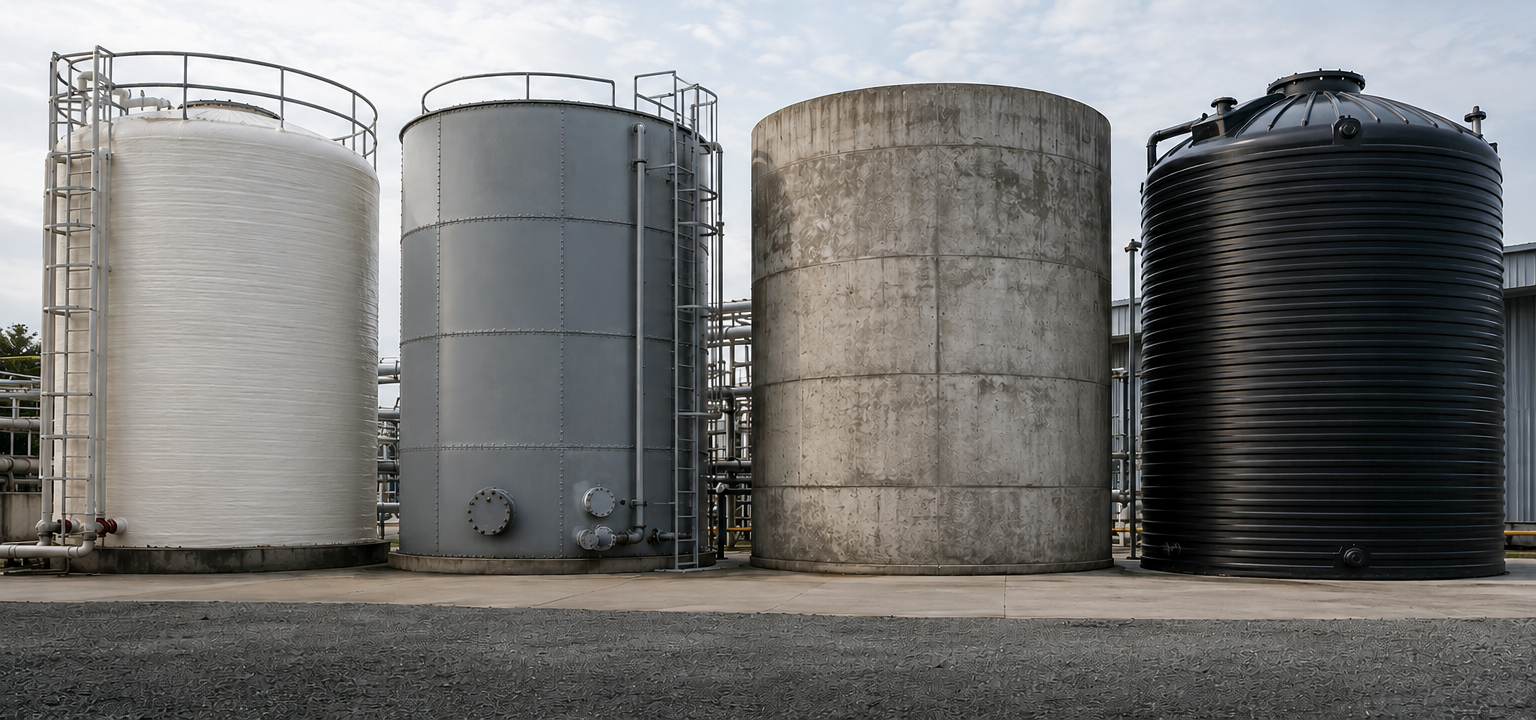
Choosing a storage tank isn't just about capacity. The material you pick decides how long the tank lasts, how much it costs you in repairs, and whether it can even handle what you plan to store in it. Chemicals, industrial water, effluent, or drinking water each demands something different from the tank wall.
Four materials dominate the market today: FRP (Fiber Reinforced Plastic), steel, concrete, and HDPE. Each has genuine strengths. This guide breaks down how they actually compare, so you can match the material to your site instead of defaulting to whatever's most familiar.
Why Tank Material Selection Is More Critical Than It Looks ?
A tank isn't a one-time purchase it's a 10 to 25-year commitment sitting on your site, often holding something corrosive, pressurized, or simply expensive to replace if it fails. Get the material wrong and you're looking at :
- Corrosion or rust contaminating stored liquid
- Frequent patchwork repairs that add up in cost
- Structural failure under chemical or weather stress
- Higher long-term maintenance than the upfront saving justified
That's why the decision deserves a proper side-by-side comparison rather than a quick call based on price alone.
FRP Tanks : Strength, Corrosion Resistance, Weight, Lifespan
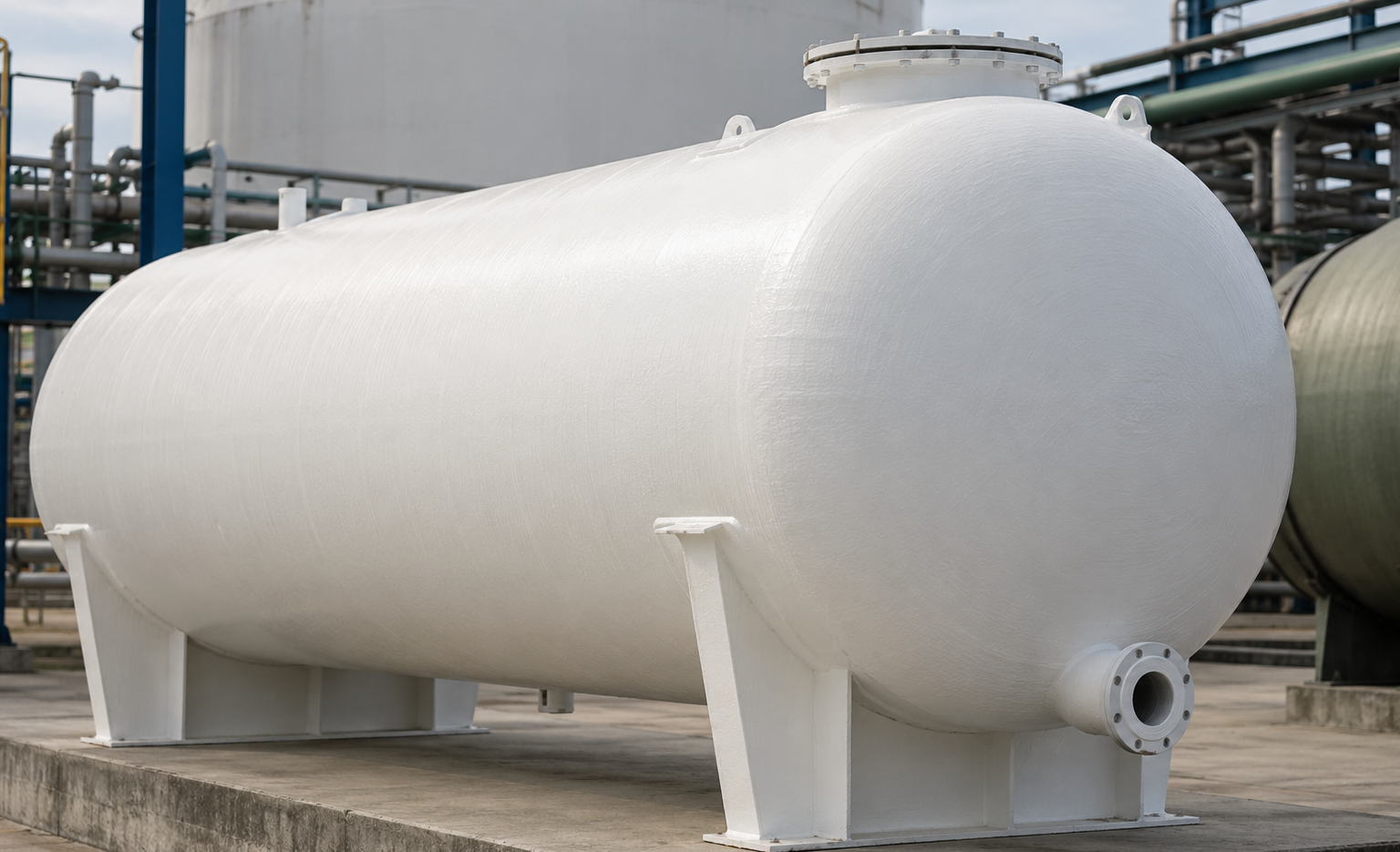
FRP tanks are built from fiberglass-reinforced resin, layered and cured to form a seamless, corrosion-proof shell.
Strengths :
- Naturally corrosion and rust-proof no coating required, no degradation from chemical exposure
- Lightweight, which cuts transport and installation cost significantly
- Smooth internal surface resists scaling and bacterial buildup
- Can be custom-molded to size, shape, and nozzle configuration
- Typical lifespan of 20-25 years with minimal upkeep
- Handles a wide range of chemicals, acids, and industrial effluents without lining
Trade-offs :
- Higher upfront cost than HDPE for small tanks
- Large-capacity tanks need skilled fabrication, so manufacturer quality matters
FRP is generally the strongest all-round choice where corrosion resistance and low maintenance matter more than the lowest possible sticker price.
Steel Tanks : Where They Still Win
Steel tanks (mild steel or stainless steel) remain common in heavy industry, especially where high pressure or extreme temperature is involved.
Strengths :
- Excellent for high-pressure and high-temperature applications
- Very high structural strength for large industrial installations
- Stainless steel variants handle food-grade and pharma storage well
Trade-offs :
- Mild steel corrodes without regular coating, lining, or cathodic protection
- Heavier higher transport and foundation costs
- Ongoing maintenance cost (repainting, anti-rust treatment) adds up over the tank's life
- Stainless steel is durable but expensive upfront
Steel still makes sense for pressure vessels and specific high-temperature processes where FRP isn't rated to perform.
Concrete Tanks: Pros, Cons, Ideal Use Cases
Concrete (RCC) tanks are typically built in-situ and used for large-volume water storage municipal water tanks, underground sumps, and large effluent basins.
Strengths :
- Very high volume capacity, well suited to underground and semi-underground storage
- Strong structural stability, long service life if built well
- Cost-effective at very large scale
Trade-offs :
- Long construction timeline weeks, not days
- Prone to cracking and leakage over time, especially with poor curing or ground movement
- Needs waterproofing treatment or FRP/epoxy lining for chemical storage
- Not portable it's a permanent civil structure
Concrete is the right call for very large, fixed, in-ground storage where capacity trumps flexibility.
HDPE Tanks : Pros, Cons, Ideal Use Cases
HDPE (High-Density Polyethylene) tanks are the common black or blue plastic tanks used widely for residential and small commercial water storage.
Strengths :
- Lowest upfront cost among the four
- Lightweight and easy to install
- Adequate for storing plain water and mild chemicals
Trade-offs :
- Shorter lifespan (typically 8-12 years) UV exposure degrades the material over time
- Lower structural strength not suited to large industrial capacities
- Limited chemical resistance compared to FRP
- Can develop cracks or become brittle in extreme temperatures
HDPE works well for smaller water storage needs where budget is the primary driver and the tank isn't handling aggressive chemicals.
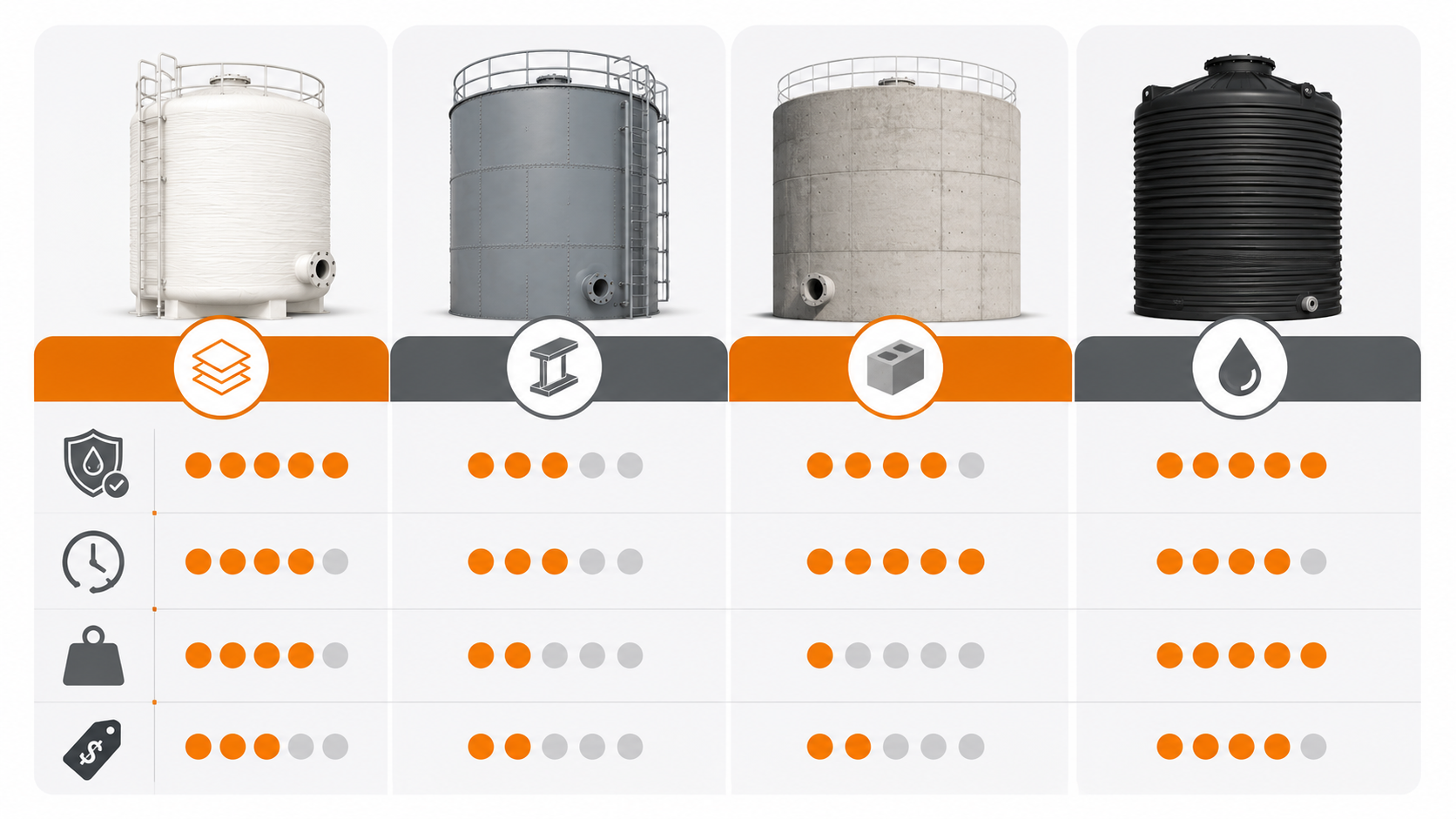
Side-by-Side Comparison
| Factor | FRP ⭐ | Steel | Concrete | HDPE |
|---|---|---|---|---|
| Corrosion Resistance | Excellent | Needs coating / maintenance | Needs lining for chemicals | Good for mild use |
| Lifespan | 20 - 25 Years | 15 - 20 Years (With Upkeep) | 25+ Years (If Well Built) | 8 - 12 Years |
| Weight / Installation | Light, Fast Install | Heavy, Needs Cranes | Heaviest, Longest Build Time | Light, Fast Install |
| Maintenance Cost | Low | Moderate - High | Moderate (Lining / Waterproofing) | Low - Moderate |
Which Industries Should Choose FRP Tanks ?
FRP tends to be the strongest fit for :
- Chemical processing - resists acids, alkalis, and solvents without lining
- Water treatment plants - corrosion-free storage for raw and treated water
- Dairy and food processing - smooth interior resists bacterial buildup
- Pharmaceutical storage - consistent, contamination-free surface
- Effluent treatment (ETP/STP) - durable against aggressive waste chemistry
Based in Pune and serving industrial and commercial clients across India, we manufacture FRP tanks built to match the exact demands of your site not a generic off-the-shelf spec.
Frequently Asked Questions
HDPE tanks usually cost less upfront, especially in smaller sizes. But FRP tanks last roughly twice as long (20–25 years vs 8–12 years) and need less maintenance, so the total cost over the tank's life is often lower with FRP.
Yes. FRP tanks are naturally corrosion-resistant and can be manufactured with resin grades matched to specific chemicals, acids, or alkalis without needing an internal lining, unlike steel or concrete.
FRP tanks typically last 20–25 years with minimal upkeep. Steel tanks can last 15–20 years, but only with regular maintenance such as recoating and rust prevention.
Yes, FRP tanks can be custom-molded for a wide range of capacities and are widely used in water treatment, chemical processing, and effluent treatment plants. For very large, fixed, in-ground storage, concrete may still be preferred.
No. FRP tanks need very little maintenance no repainting, no anti-rust treatment, and no periodic lining like concrete tanks often require. Occasional visual inspection is usually enough.
Need Help Choosing the Right Tank for Your Application?
Our experts will help you select the ideal FRP tank based on your application, storage capacity, and industry requirements. Get professional guidance and a personalized recommendation— completely free.
-
Phone:
+91 9850400919
-
Gat No.116, Talawade Rd, Jyotiba Nagar, Talwade, Pimpri-Chinchwad, Pune, Maharashtra 412114.
-
email:
sales@classicfrp.com
About Us
Established in the year of 2007, “Classic Frp Products” are Manufacturer of extensive FRP Portable And Prefabricated Security Cabin, FRP Portable Toilet.
Our Products
- FRP Portable Toilet
- Portable Security Cabin
- Portable Toilet